In-House vs Agency: What Marketing Leaders Need to Know
Pick an agency when you need fast, specialist execution and scale. Pick in-house when you need deep brand ownership and the kind of institutional knowledge that compounds over years. For most companies in the mid-market revenue range, neither extreme wins outright.
TL;DR:
- Agency wins when you need to launch fast, access specialist talent, or run high-volume campaigns without the overhead of a full team.
- In-house wins when brand consistency, IP control, and long-term cost efficiency on repetitive tasks matter more than speed or breadth.
- Hybrid wins for most mid-market companies: one internal strategy owner plus targeted agency retainers typically outperforms both pure models in the $5M–$50M band.
Your next step: Run a break-even calculation that includes fully loaded salary costs, tool subscriptions, and the internal hours required to act on any software you buy. That math usually tells you more than any framework.
Table of Contents
- How do in-house and agency models actually compare?
- What do “in-house” and “agency” actually mean day-to-day?
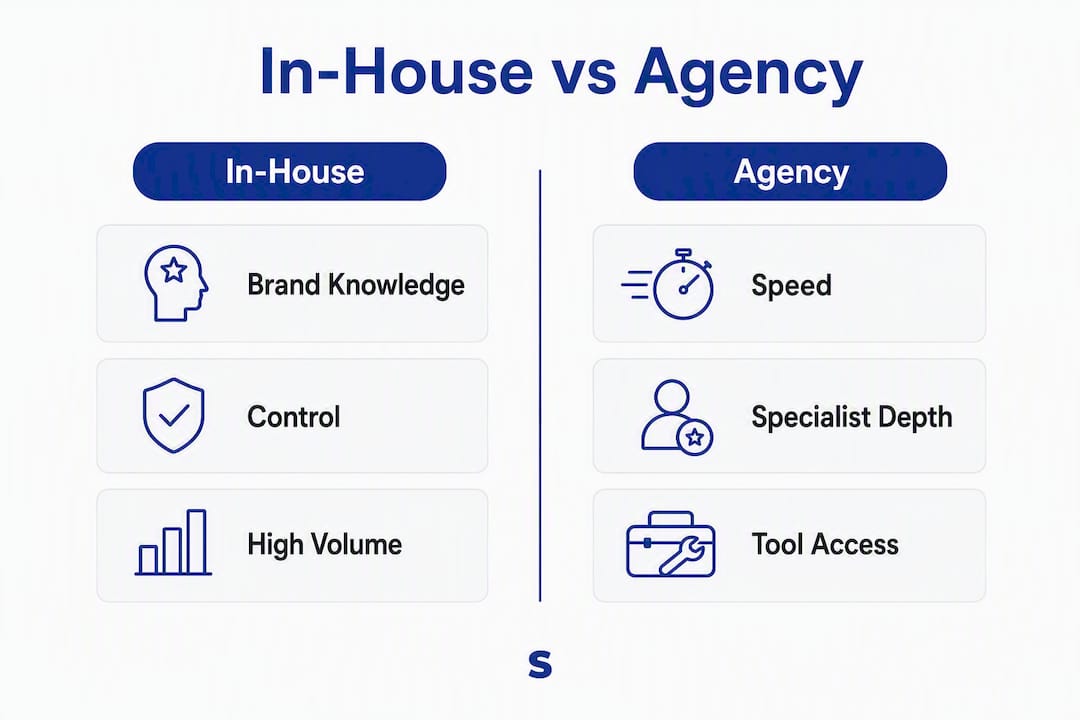
- Why in-house teams have real advantages
- The real downsides of building in-house
- Where agencies genuinely win
- When agencies become a liability
- How do you choose between in-house, agency, or hybrid?
- What does it actually cost? A realistic breakdown
- How to switch models without losing momentum
- What the research says about the hidden trade-offs
- Key Takeaways
- The Selloop perspective on this debate
How do in-house and agency models actually compare?
| Dimension | In-House | Agency |
|---|---|---|
| Best for | Ongoing brand work, high-volume repetitive tasks, IP-sensitive campaigns | Fast launches, specialist sprints, companies without a full team |
| Cost shape | Fixed salaries plus employer overhead, paid whether or not there is work that month | A variable fee you can scale with scope, with no employer-side costs attached |
| Speed & turnaround | Slower to spin up; faster once embedded | Faster to launch; may slow on revisions without clear briefs |
| Control & brand knowledge | High — team lives inside the brand | Lower — requires strong onboarding and ongoing alignment |
| Tool access | Limited to your budget; enterprise tools are expensive | Broad access to enterprise platforms spread across clients |
| Career growth | Depth, domain expertise, clearer promotion paths | Breadth, faster skill growth, less brand ownership |
| Work-life balance | More predictable hours; internal politics can add friction | Variable — agency pace can be intense, especially at launch |
| Scalability | Slow to scale up or down | Flexible — add or reduce scope without headcount changes |
Pick in-house if: You have a defined strategy, repetitive high-volume work, and the budget to hire leadership before specialists.
Pick an agency if: You’re pre-$5M, launching into a new channel, or need a capability you can’t justify hiring full-time.
The hybrid model — one internal strategy lead plus agency retainers for execution — is now the dominant pattern among successful mid-market brands. It gives you brand stewardship without the overhead of a full department.
What do “in-house” and “agency” actually mean day-to-day?
In-house means your marketing function sits inside the company as employees. That ranges from a single generalist to a full department with specialists in paid media, content, design, and analytics. Some larger companies build what’s called an “in-house agency” — a dedicated internal team that operates like an external shop, complete with creative briefs and project management, but serves only internal stakeholders.
Agency means you contract an external firm to run some or all of your marketing. The engagement shapes vary considerably:
- Retainer: A fixed monthly fee for ongoing work — the most common model for SEO, paid media, and content.
- Project-based: A defined scope with a start and end date, common for rebrands, campaign launches, or audits.
- Fractional CMO: A senior strategist who works part-time across multiple clients — useful when you need leadership without the full-time cost.
- Performance-based: Fees tied to outcomes like leads or revenue, more common in performance marketing.
One important overlap: agencies use commercial tool stacks and sometimes retain sub-agencies for specialist work. In-house teams often do the same, retaining agencies for channels where they lack depth. The line between the two models is blurrier in practice than most frameworks suggest.
Why in-house teams have real advantages
Deep brand knowledge is the clearest win. An in-house marketer who has been inside a company for two years knows the product roadmap, the sales team’s objections, the customer language that converts, and the internal approval process. That context is genuinely hard to hand off to an external team, and it shows in the quality of the output.
Control is the second advantage. You set the priorities. You own the IP. Messaging decisions don’t require a client-agency approval loop, which matters when you’re moving fast on a product launch or a PR situation. Cross-functional collaboration with sales, product, and customer success is also faster when everyone sits in the same Slack workspace.

For high-volume, repetitive tasks — think weekly email campaigns, ongoing paid search management, or regular social content — in-house teams often become more cost-efficient over time once the ramp-up period is behind them. The institutional knowledge compounds; the agency retainer doesn’t.
For marketers building a career, in-house roles offer domain depth and clearer promotion paths. You become the expert on one brand, one customer, one market. That’s valuable, especially in industries where product complexity is high.
Pro Tip: When building your first in-house team, hire leadership before specialists. A marketing director or VP who can set strategy and manage agencies is more valuable than three channel specialists with no one to coordinate them. Add the specialists once you have measurement and direction in place.
Whatever your market pays a mid-level marketing hire, the fully loaded cost lands well above that base salary once you add employer payroll taxes, benefits, equipment, and software. Price the role against your own local market data rather than a national average — the gap between a national median and what you will actually pay in your city, for your seniority band, is usually wide enough to change the decision.
The real downsides of building in-house
The fully loaded cost is the first shock. Salary is just the start. Add employer payroll taxes, health insurance, 401(k) contributions, equipment, software licenses, and the cost of the role sitting vacant during a 60–90 day recruiting cycle. A team of three to four people multiplies every one of those line items by three or four — and none of it includes the enterprise tooling you still have to buy on top.
Recruiting niche specialists is genuinely difficult. Finding someone who is strong in both paid search strategy and analytics, or in both brand creative and performance copy, is rare. Most companies end up with a generalist who is stretched thin or a specialist who can’t cover adjacent needs. Single-point-of-failure risk is real: when your one paid media person leaves, your campaigns don’t run.
Internal friction adds hidden costs too. Meeting overhead, cross-departmental politics, and the slower pace of internal approvals all eat into the productivity gains you expected. Scaling up for a major campaign launch is also slow — you can’t hire a contractor team in two weeks the way an agency can.
The most common hiring mistake: Companies build in-house before they have a strategy. They hire a social media manager or a paid search specialist, then realize six months later that no one owns the overall marketing direction. Specialists without a strategic owner produce activity, not outcomes. Hire the strategist first.
Where agencies genuinely win
Speed and specialist depth are the two clearest advantages. An established agency can launch a paid search campaign in days, not weeks. They have copywriters, designers, media buyers, and analytics people already working together. You’re not building that team — you’re renting it.
Tool access is a less obvious but significant advantage; agencies often leverage enterprise search, analytics, and creative tooling that would be costly for individual companies to access directly. Enterprise platforms for SEO, creative testing, ad automation, and competitive intelligence can be expensive when purchased directly. Agencies spread those costs across their entire client base, so you get access to enterprise-class tools that typically cost $5,000–$10,000 per month directly for much less as their client.

Cross-account pattern recognition is another edge. An agency running paid media for 30 clients sees what’s working across industries, audiences, and platforms in real time. That signal is hard to replicate inside a single brand.
For marketers, agency careers accelerate skill growth. You work across multiple clients, industries, and channels in a compressed timeframe. The trade-off is less brand ownership and, often, less predictable hours. Junior agency roles can be intense, but the breadth of experience tends to translate well when moving into senior in-house positions later.
Agencies also carry a compliance bench. Legal review, brand safety checks, and platform policy expertise are often built into the team. For regulated industries, that reduces risk in ways that are hard to price.
When agencies become a liability
The strategy ownership gap is the most common failure mode. An agency can execute brilliantly against the wrong brief. If no one inside your company owns the KPIs, the prioritization, and the connection between marketing activity and business outcomes, the agency will fill that vacuum with activity metrics that look good in a report but don’t move revenue.
Variable resourcing is a real risk too. The senior strategist who sold you the engagement may not be the person managing your account day-to-day. Junior staff handling your campaigns is common, especially at larger agencies where senior talent is spread thin across accounts.
Vendor dependency compounds over time. If your agency owns your ad account history, your keyword lists, your creative assets, and your reporting dashboards, switching becomes expensive and disruptive. Knowledge lock-in is a structural risk, not an edge case.
How to mitigate the main agency risks:
- Require a named account team in the contract — not just a title, but a specific person.
- Set clear SLAs for reporting cadence, response times, and escalation paths.
- Insist on owning all accounts, assets, and data from day one.
- Hire a fractional CMO or internal strategy lead to own KPIs and brief the agency.
- Build in a 90-day performance review with defined thresholds before committing to a longer retainer.
- Run an onboarding audit at the start: map every tool, every login, every data source.
How do you choose between in-house, agency, or hybrid?
Start with your business inputs before you look at any framework. Revenue range, campaign volume, product complexity, speed requirements, IP sensitivity, and whether you have an internal leader who can own strategy — these inputs determine the answer more reliably than any rule of thumb.
Decision checklist:
- Do you have a defined marketing strategy and someone to own it internally? If no, an agency or fractional CMO should come first.
- Is your monthly ad spend or content volume high enough to justify a full-time specialist? If no, an agency or freelancer is more efficient.
- Do you need to move in the next 30–60 days? Agency wins on speed.
- Is brand consistency and IP control a hard requirement? In-house wins here.
- Are you between $5M and $50M in revenue with a defined channel mix? Hybrid is likely the right model.
Questions to ask agencies before signing:
- Who specifically will manage our account, and what is their experience level?
- How do you handle strategy ownership — do you expect us to brief you, or do you set direction?
- What tools do you use, and do we retain access if we leave?
- How do you report results, and against which KPIs?
Red flags to watch for:
- No named account manager in the proposal
- Opaque pricing with no breakdown of what’s included
- Agency owns your ad accounts or creative assets
- No defined escalation path when performance drops
One-line rules for quick decisions:
- For companies with lower revenue, starting with an agency or freelancer plus fractional strategic support is recommended.
- For mid-market companies, a hybrid model with internal strategy leadership plus agency retainers is often optimal.
- For larger companies, consider building a full in-house team while retaining agencies for specialist channels.
Pro Tip: Before committing to either model, run a 30-minute break-even exercise. List your fully loaded in-house cost (salary + benefits + tools + overhead) against your agency retainer plus any tool costs you’d still need to buy. The gap is usually smaller than you expect — or larger in the other direction.
What does it actually cost? A realistic breakdown
The honest cost comparison requires including every line item, not just the salary or the retainer headline.
Fully loaded in-house costs include:
- Base salary plus employer payroll taxes (roughly 7.65% for FICA alone)
- Health, dental, and vision benefits
- 401(k) match and other benefits
- Software and tool subscriptions
- Equipment and workspace
- Recruiting fees and the cost of vacancy during hiring
Agency retainers typically include the labor hours, the tool stack, and often creative production. What they don’t include is your internal time to brief, review, and manage the relationship — budget at least 5–10 hours per week for that.
| Cost line | In-house | Agency |
|---|---|---|
| Headline cost | Salary for every role you hire | Monthly retainer or project fee |
| Employer overhead | Payroll taxes (~7.65% FICA alone), benefits, 401(k), equipment | None — carried by the agency |
| Tooling | Bought per seat at list price | Usually bundled into the retainer |
| Time to productive | 60–90 day recruiting cycle, then onboarding | Days to weeks |
| Your management time | Absorbed into the existing team | 5–10 hours per week to brief, review, and align |
| Cost of scaling down | Severance, plus the institutional knowledge that walks out | The notice period written into the contract |
Run your own numbers against those six lines rather than trusting a benchmark range. The comparison only becomes honest once the employer-side costs and your own management hours are priced in — those are exactly the two lines most in-house-versus-agency comparisons leave out.
For Amazon sellers specifically, the true cost math must include the hours required to act on any software you buy. A PPC tool priced per month assumes someone is spending several hours each week reviewing recommendations, approving changes, and monitoring results. If that time isn’t available, the tool’s value drops sharply. An agency retainer bundles those labor hours into the fee.
How to switch models without losing momentum
Whether you’re moving from agency to in-house or the reverse, the transition period is where most knowledge gets lost. A structured handoff prevents that.
Agency to in-house (30–60–90 day plan):
- Days 1–30: Audit every tool, account, and data source. Get admin access to all platforms before the agency relationship ends. Document current KPIs, campaign structures, and reporting templates.
- Days 31–60: Hire your strategy lead first. Begin parallel running — new hire shadows agency work before taking ownership. Map every workflow and approval process.
- Days 61–90: Full handoff. Agency moves to advisory or ends. New team owns all accounts, briefs, and reporting. Run a retrospective to capture what worked.
In-house to agency:
- Start with a pilot project, not a full retainer. A 90-day campaign gives you real performance data before a long-term commitment.
- Brief the agency on your brand voice, customer segments, and historical performance data before they touch anything.
- Keep one internal person as the strategy owner and agency liaison. Don’t hand over strategy along with execution.
- Common pitfall: losing historical ad account data. Export everything before access changes hands.
What the research says about the hidden trade-offs
The strategy gap is the finding that shows up most consistently across industry analysis. When strategy ownership is unclear between client and agency, outcomes suffer. The recommendation is consistent: hire a fractional CMO or internal lead to own strategy before you hire any agency for execution.
The most common failure mode isn’t a bad agency or a weak in-house team. It’s the absence of a clear strategy owner. When no one inside the company owns the KPIs and the brief, agencies optimize for the metrics they can control — impressions, clicks, deliverables — rather than business outcomes. A fractional CMO or senior internal lead fixes this at a fraction of the cost of a full-time CMO.
The tool-access finding is equally important and consistently underpriced in cost comparisons. Agencies give access to enterprise platforms that would cost a single company thousands of dollars per month to license directly. When you’re comparing an agency retainer to an in-house build, that tool value needs to be on the in-house cost side of the ledger.
The practical recommendation before making any model decision: run a “hours to act” audit. For every tool you’re considering buying, estimate the weekly hours your team would need to spend acting on its recommendations. Multiply by your internal hourly rate. Add that to the tool cost. Compare that total to an agency retainer that includes both the tool and the labor. For AI-driven tools and PPC software, this math often shifts the decision more than the sticker price does.
Key Takeaways
For most companies between $5M and $50M, a hybrid model with an internal strategy owner and targeted agency retainers outperforms both pure in-house and pure-agency approaches on cost, speed, and output quality.
| Point | Details |
|---|---|
| Hybrid wins for mid-market | Companies between $5M and $50M typically get the best results combining an internal strategy lead with agency execution. |
| Hire strategy before specialists | Build in-house by hiring a marketing director or fractional CMO first — specialists without direction produce activity, not outcomes. |
| True cost includes tool hours | Factor in the weekly hours needed to act on any software; that labor cost often closes the gap between tools and agency retainers. |
| Agency risk is the strategy gap | Without an internal owner of KPIs and briefs, agencies optimize for deliverables rather than business results. |
| Run a break-even before deciding | Compare fully loaded in-house costs against agency retainer plus internal management time before committing to either model. |
The Selloop perspective on this debate
The in-house vs agency debate gets framed as a binary too often, and that framing causes real damage. Companies either over-invest in headcount before they have strategy, or they hand everything to an agency and lose the institutional knowledge that makes marketing compound over time.
The hybrid model is the honest answer for most marketing leaders, but it only works if someone inside the company owns the strategy. That person doesn’t need to be a full-time CMO. A fractional CMO, a strong marketing director, or even a senior generalist with clear authority over KPIs and agency briefs is enough. The agency executes. The internal lead ensures the execution connects to the business.
For Amazon sellers navigating this same question on the PPC side, the calculus is similar. A full-service Amazon agency handles everything but costs accordingly. Software tools give you control and visibility at a lower price point, but only if someone has the time and expertise to act on the recommendations. Selloop sits in the middle: AI-driven analysis that surfaces exactly where your ad spend is working and where it isn’t, with one-click approvals and 21-day result tracking so you’re not guessing whether a change worked. It fits naturally into a hybrid setup where you want to stay close to your campaigns without spending hours in spreadsheets or paying agency-level retainers for basic optimization.
The right model isn’t the one that sounds most sophisticated. It’s the one that matches your revenue stage, your internal capacity, and your willingness to own strategy. Start there, run the break-even math, and the answer usually becomes obvious.